Digital clutter is any business information that has no single agreed home. It is not the size of your inbox or the state of your desktop. It is the six places your work scatters itself: unresolved decisions sitting in email, a downloads folder doing the job of a filing cabinet, file names nobody could search, client details split across your CRM and your DMs and your memory, forty open tabs standing in for a to-do list, and a graveyard of things you saved for later. The test for whether any of it matters is one question, and it is at the bottom of this post.
This is a systems problem rather than a tidiness problem, which is why every cleanup you have done so far stopped holding within about three weeks.
The short version
- Digital clutter is ambiguity, not volume. The problem is not how much you have. It is that a given thing could reasonably live in four places, so it ends up in none of them.
- Check the six places. Inbox, downloads, file names, client information, open tabs, saved-for-later. Almost all of it hides in those.
- Run the one question. How long did it take to find the last thing you went looking for? That single answer tells you whether this is costing you anything.
- Cleanups do not hold. Clutter arrives daily, so any fix that relies on you tidying manually will drift back.
- Fix one category properly. Usually client details. One category done well beats everything reorganized badly.
The six places digital clutter hides
When women tell me their digital space is a disaster, they almost always point at their desktop. The desktop is rarely the expensive part. These six are.

Look at number four for a second. Client information spread across email, DMs, a spreadsheet, your CRM, and your memory is the one that costs actual money. It is how a detail someone told you in an Instagram DM never makes it into the proposal, and how you walk into a call already slightly behind.
Why cleaning it up never seems to stick
A cleanup is an event. Clutter is a process. Every single day adds new files, new emails, new voice notes, new screenshots. Any system that depends on you tidying manually is a system competing with your actual work, and your actual work wins every time.
So the honest reason your last reorganization drifted back is not discipline. You built a thing that required daily maintenance from the most overloaded person in the business.
The one question that tells you whether this is costing you
There is a simpler diagnostic than any audit.
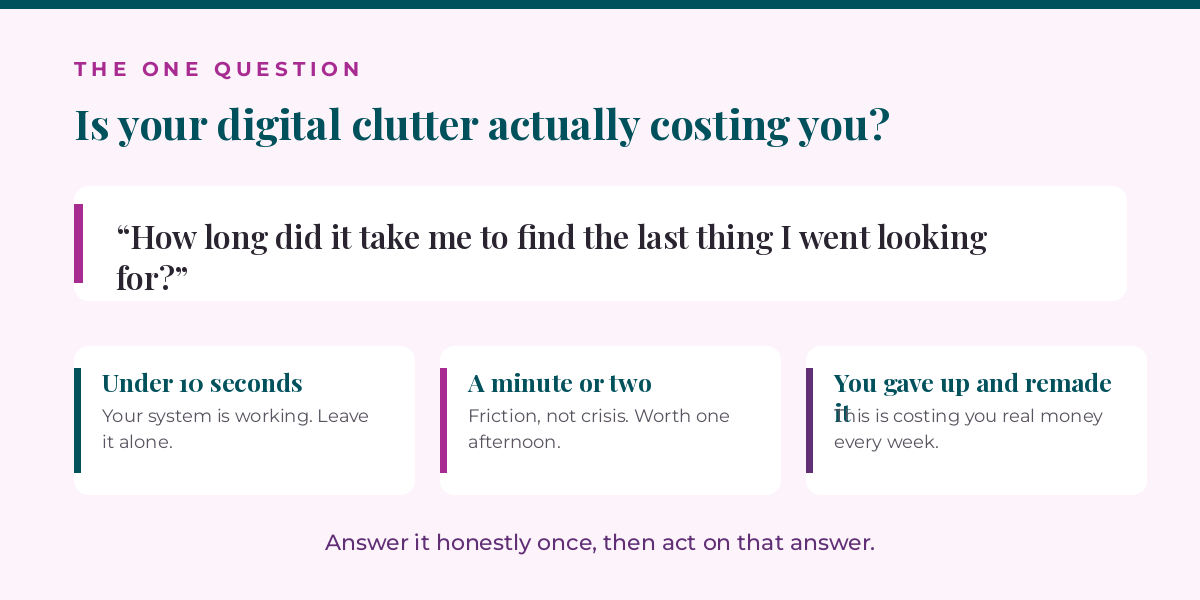
If you gave up and remade the thing, that is the answer. You are paying for the same work twice, most weeks. That is worth fixing. If you found it in ten seconds, your system is working and you have my full permission to leave it alone and go do something that actually grows the business.
Start with one category, not all of them
Pick the single type of information that has cost you the most this month. For most women running a service business it is client details. Give that one thing a home this week and leave everything else exactly as it is.
The next post covers what to do once you have picked it: the one-home rule and the three AI employees that do the maintaining, so the cleanup happens once instead of every quarter. If travel is what you are protecting this capacity for, the travel-ready test shows what else needs to be true.
Questions women entrepreneurs are asking about this
What counts as digital clutter?
Digital clutter is any business information that has no single agreed home. An inbox holding decisions that live nowhere else, a downloads folder acting as permanent storage, files you cannot find by searching, and client details spread across five tools all count. Volume is not the issue. Ambiguity about where things live is.
How do I know if digital clutter is actually costing me anything?
Ask how long it took to find the last thing you went looking for. Under ten seconds means your system works. A minute or two means friction worth one afternoon of attention. If you gave up and remade the thing from scratch, it is costing you real money every week.
Why does organizing my files never seem to stick?
Because a cleanup is an event and clutter is a process. Every day adds new files, emails, and notes, so a system that depends on you tidying manually will drift back within weeks. The fix is deciding where each type of thing lives, then handing the ongoing filing to something that does it without being asked.
Is digital clutter really a business problem or just annoying?
It is a business problem when it shows up in your delivery. Rewriting something you already made, missing a client detail you were told in a DM, or losing twenty minutes before a call hunting for a file are all revenue and reputation costs, not tidiness preferences.
Where should I start if my digital space is a mess?
Start with the one type of information that has cost you the most this month, usually client details. Give that one thing a single home before touching anything else. Fixing one category properly beats reorganizing everything badly.
>If the mess is a symptom of something bigger
Sometimes disorganization is the actual bottleneck. Often it is a symptom of a business that grew past the systems it started with, which is a different and more interesting problem. I wrote about how to tell the difference in the piece on finding your real bottleneck before you automate anything.
If it turns out your bottleneck is where clients come from rather than where files live, The $65K Networking System is the 90-minute class on the exact system I used to make $65,000 from online networking in two years, plus the AI employees that run the follow-up.
Get The $65K Networking System for $47
ABOUT MARYBETH WELTY
Marybeth Welty is a business coach, systems strategist, and founder of Women Entrepreneurs Who Travel and Sustainable Lifestyle Solutions. She has spent 19 years traveling between the US and Canada and across 11 countries, building and running her businesses from villas, co-working spaces, cafes, and everything in between.
These days she builds AI employees: the assistants, planners, and follow-up systems that run the parts of a business that used to take up half of a founder’s whole week. She helps women entrepreneurs put those systems, their offers, and their mindset together so they can work from anywhere and actually enjoy the life they built the business for.
Follow her on Instagram @marybethwelty, or come join the free Facebook community, Women Entrepreneurs Who Travel.